
I'm thrilled to tell you about the journey of Juno.
The company began by assisting Harvard MBA grads in finding bank loans at incredibly competitive rates.
What is Juno? What does "using group strength to get better rates" mean? How did they start getting customers? And most importantly, why is their story important to tell?
Why should we share their Juno story?
The Juno story is important to share for two reasons.
Firstly, it's a story of solving the persistent issue of education loans.
Secondly, it serves as a case study for a strategy based on partnership-driven customer acquisition.
Partnership-driven companies are unique because they must create an advantage that partners can't copy easily. It is a tough task.
Juno successfully brought the idea of group buying for student loans, a concept from Israel, to the US.
Before continuing, it's worth understanding: What does "group buying power" mean?
In simple terms, group buying means bringing many small transactions together to create a larger order. This gives you more influence in the transaction. Juno uses this idea for private student loans.
When you're a single person borrowing money for education, you don't have much control over the lender. But if you join forces with thousands of other students seeking loans, the group can probably negotiate better rates than each person dealing with the lender individually.
Every year, Juno forms groups of students (MBAs, Grads, or Undergrads) who want loans, and they negotiate special rates for the whole group. While each person's rate varies based on credit, everyone gets a better deal than if they approached the lender alone. This shows how powerful group buying can be!
Juno dared to think big.
They envisioned gathering more students needing loans than a bank could attract on its own. Their goal was to reach out and connect with three times the amount of students compared to what bank marketers could achieve by themselves.
What's the story of Juno's beginning days?
Nikhil and Chris, two MBA students joining Harvard Business School, learned about group buying for student loans from another student.
Nikhil took a bold step. He messaged other new Harvard students, suggesting an experiment. He wanted to negotiate student loans for all interested students.
What was the first big challenge or obstacle that Juno faced?
The initial 70 users joined after a Google form was shared in the incoming students' chat. This form lets people choose to be part of the new Harvard MBA negotiation group idea. It helped the team gather everyone's requests to later present to lenders.
Starting with about $4 million in loans, Nikhil and Chris reached out to banks and lenders for a better deal for themselves and their classmates. But luck wasn't on their side; the volume wasn't big enough for anyone to pay attention. To make it work, they had to grow the group quickly (at least ten times) within 60 days.
What approach did they use to conquer the challenge?
The task of increasing their user base by tenfold within 2 months (to meet school tuition deadlines) started with creating a community around their idea.
Communities generally come in two types:
- Goal-Focused Communities: People unite for a shared objective, like finding a new job or achieving financial stability.
- Identity-Centric Communities: Members connect with those who have similar traits or qualities.
When Juno initially worked on forming a community to negotiate student loans, they combined elements from both types. They created an identity by being exclusive to "top MBA programs" and united people around the goal of achieving lower rates.
- They formed a close-knit community where individuals had common interests and could relate closely to others. This created trust.
- They also established a group of motivated individuals, all focused on achieving the same goal of obtaining improved student loan rates. This gave the community a strong sense of purpose.
With trust and purpose firmly ingrained in their community, Nikhil and Chris could inspire the initial group of around 70 users to bring in more people to join their cause actively.
What were the three methods they employed to attract additional members?
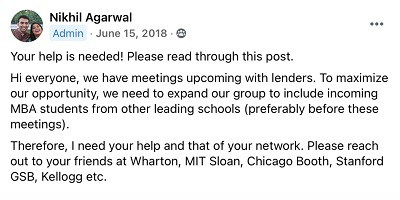
Creating Incentive Alignment: In their frequent pitches to the Facebook group community, their core message emphasized that "the more individuals who become part of our group, the higher the chances of negotiating a favourable deal for everyone." To put it differently, as everyone contributes to the group's expansion, all members will benefit more compared to not participating.
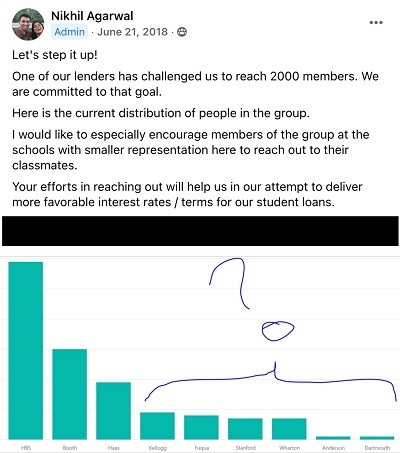
Encouraging Accountability: Building on the previous point, it could negatively affect the entire group if certain individuals aren't actively participating. Publicly highlighting campuses that lacked engagement created social pressure for students from those places to step up and invite more members from their university's group chats and online communities.
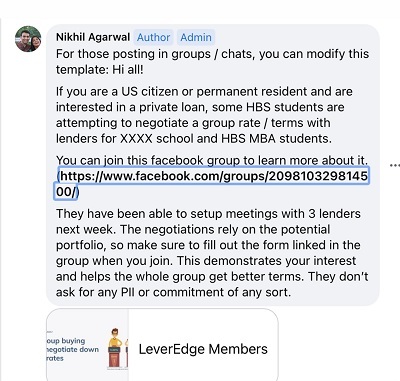
Making Things Easier: To speed up their growth, they provided community members templates and essential talking points they could readily share with their peers.
What was achieved?
With just a Facebook group and a Google form, Nikhil and Chris formed a negotiation group of more than 700 students from 10 business schools. They secured a partnership with a lending company within just 2 months. Out of the 700 members, more than 50% chose the negotiated deal facilitated by Juno.
How big is Juno today?
So far, more than 70,000 individuals have joined Juno's negotiations and have collectively obtained over $400 million in negotiated loans.
Since their initial negotiation, Juno has duplicated this approach in areas like loan refinancing and international student health insurance. They've also broadened their scope to include MBAs, Undergrads, and Grads. Across these various sectors, they continue the same process:
- Gathering a significant number of students
- Approaching the market
- Negotiating collectively for the benefit of everyone