
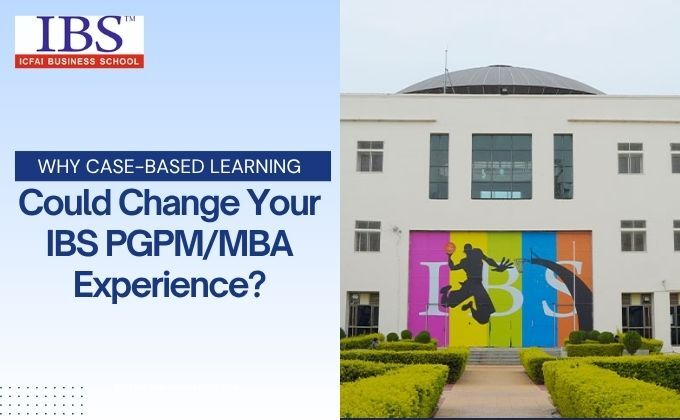
Cases and scenarios are the central component to learning a MBA/PGPM at ICFAI Business School (IBS). In addition to books, students of the programme experience and face real business situations, debate the difficulties encountered, identify the best options, and share the solutions. This approach not only trains students to think critically but also enables them to overcome challenges effectively. This article will discuss how the IBS MBA/PGPM students experience case methods while using the teaching approach and this way learn to handle the management challenges.
IBSAT 2026 Registration Open
 What Is Case-Based Learning?
Case-based learning is a strategy that employs business scenarios as the foundation for educational experience. The case study might necessitate students to scrutinize the company's standing, pinpoint the primary issue, assess the data and make a choice on how it should be played out next.

|
Traditional Learning Focus |
Case-Based Learning Focus |
|
Understanding concepts |
Applying concepts |
|
Studying theories |
Analysing business situations |
|
Finding expected answers |
Evaluating alternatives |
|
Individual understanding |
Discussion and collaboration |
|
Learning from textbooks |
Learning through practical situations |
 Why Could It Change Your IBS PGPM/MBA Experience?
1. You Learn to Think Like a Decision-Maker
Business scenarios rarely provide all the required information. Managers frequently have to work with limited data, competing priorities and different expectations from stakeholders. Cases and debates can put students in comparable situations. Through analysis of a case and justification of a position, students can develop their decision-making skills and not just memorise theories.
|
Skill Developed |
How Case Learning Helps? |
|
Critical Thinking |
Encourages students to question assumptions |
|
Analytical Reasoning |
Helps evaluate information and identify key issues |
|
Problem-Solving |
Promotes practical approaches to business challenges |
|
Decision-Making |
Builds confidence in evaluating alternatives |
|
Strategic Thinking |
Encourages students to consider wider business implications |
2. Concepts Become More Practical
One of the reasons management studies attract many candidates is that the curriculum varies from finance, marketing operations, human resources to strategy, which is the core area of these courses. To understand the theories is a step forward towards understanding the matter. Though, the real learning comes out when you are able to put them to work.
|
Management Area |
Possible Case-Based Application |
|
Marketing |
Responding to changing customer behaviour |
|
Finance |
Evaluating business and investment decisions |
|
Human Resources |
Addressing employee and organisational challenges |
|
Operations |
Improving efficiency and processes |
|
Strategy |
Responding to competition and market changes |
|
Leadership |
Handling complex organisational decisions |
3. Classroom Discussion Becomes Part of Learning
In classrooms, IBS students are required, not just to read and remember a case, but to make sense of the business situation presented, identify the problems, think of and recommend alternative actions, and in a well-rounded, interactive discussion, share their thoughts on the case. Such classroom engagement is central to the learning process. Different individuals may look at the same issue in very different ways. By focusing on financial results or long-term strategy, various students bring their unique views, which can contribute not only to thinking in a wider sense but also to recognizing and valuing the perspectives of others.
4. Build Confidence in Presenting Ideas
Having a great business idea does you no good if you can not explain it well. Through case discussions, you get a chance to make recommendations, justify these recommendations and answer the raised questions. This process helps one develop one's communication and presentation skills. To make its MBA / PGPM curriculum more effective, IBS also includes in-skill and out-skill development activities like English language skills, presentation skills, interpersonal skills, team building and leadership skills.
5. Learning Can Extend Beyond the Classroom
IBS has a 14-week Summer Internship Programme (SIP) following Semester II. The programme was made to be a bridge between educational institutions and working environments.
|
Learning Experience |
What It Can Add |
|
Case discussions |
Business analysis and decision-making |
|
Classroom presentations |
Communication and confidence |
|
Team activities |
Collaboration and interpersonal skills |
|
Summer Internship |
Exposure to professional environments |
|
Management courses |
Functional and strategic understanding |
 Conclusion
Case-based learning is an effective teaching method that brings real-life business situations to class and gets students to think of how to solve them. Students have the chance to see different points of view while trying to arrive at the best decision and then share their reasoning. This style of education is highly favoured by IBS and has a major role in MBA/PGPM education programs. If you are considering becoming a management professional, this learning method will allow you to acquire the critical thinking, communication, and decision-making skills that have become the hallmarks of the modern business world.
Stay informed, Stay ahead and Stay inspired with MBA Rendezvous.